 Skip to content


Last Updated on 15/10/2025. A car accident at work can impact your life physically, emotionally, and financially while leaving you facing a potentially long recovery. Consequently, if you were injured in such an accident and it wasn’t your fault, it’s only fair to establish who is responsible and explore your options for claiming compensation. Don’t worry, here at Advice, our advisors can help you get started by answering some of the most frequently asked questions about the claims process.
Our advisors appreciate that experiencing a car accident while working can turn your life upside down. They will carefully review your situation and may connect you with one of our experienced solicitors, who will always take the time to offer long-term support throughout the claims process. When it comes to your road traffic accident, you deserve to feel confident that your solicitor will maximise your compensation and help you navigate your claim smoothly.
Your Important Questions Answered
- What causes an employee car accident at work? A multitude of catalysts can result in an accident, including human error, environmental factors and equipment failure.
- Can I claim for minor car accident injuries? Yes, you can claim for both major and minor injuries so long as they result from a third party’s negligent actions.
- Can I be sacked for making a claim? You can’t be dismissed from your job simply for starting a claim for a car accident that wasn’t your fault.
- What car accident injuries can you suffer? You can suffer a wide range of injuries from a broken pelvis to loss of limb.
- Do I need evidence to claim? Yes, absolutely, as proof can confirm that negligence has taken place and strengthen your case for compensation.
We know it’s hard to know where to begin, so why not take the first step and get in touch today using the contact details below:
- Phone us on 0161 509 2856
- Contact us online
- Use the live chat feature to talk to an expert advisor in real time.
Chat With Us Today
Select A Section:
- What Are Employee Car Accident At Work Claims?
- What Happens If You Have A Car Accident At Work?
- Steps You Could Take To Make A Car Accident At Work Claim
- Who Is Liable?
- Calculate Damages For A Work Vehicle Accident
- How To Start A No Win No Fee Car Accident At Work Claim
What Are Employee Car Accident At Work Claims?
If you are driving for work and have an accident, can you make a car accident at work claim? If you are involved in a car accident while at work, depending on your circumstances, if the accident was not your fault, you may make a personal injury claim for harm suffered against your employer or another road user.
If the accident was caused by your employer’s negligence. For example, if they provided you with a vehicle that was not roadworthy and, due to poor maintenance, caused you to suffer a road accident in which you were injured, then they would be liable for damages.
If the accident was nothing to do with your employer but was caused by the negligence of another road user then you would claim against them for any injuries suffered.
That said, on May 21st 2021, the government introduced The Whiplash Injury Regulations 2021, which brought about a change in how adult drivers and passengers now make a personal injury claim if their injuries are valued at £5000 or below. These claimants would need to use the online portal provided by the government. There is also a set of tariffs that apply in these cases.
Key Regulations
There are a number of bodies of regulations that could apply in a claim for a car accident at work. Below, we have provided some links to those that we think you may need to refer to. Alternatively, our advisors can give you some advice about these regulations.
What Happens If You Have A Car Accident At Work?
Who can make a car accident at work claim? If you are injured in a car accident, whether it is a work vehicle or not, you can only claim for injuries suffered if the accident was caused by the negligence of a third party.
There is a variety of legislation, such as the ones mentioned above, that applies a duty of care to your safety. When you are driving on the road, the Road Traffic Act 1988 and the Highway Code state that road users must drive in the same manner as any competent driver. No injuries should be caused because of negligence.
While at work, you are also protected by the Health and Safety at Work etc Act 1974. This places a duty of care on your employer to keep you as safe as can be expected while working.
When this duty of care is breached and you are injured as a result you can pursue a personal injury claim. Even if you are partially at fault but your employer or another road user is also liable you may still be able to claim.
How Could You Be Injured?
There are many ways that you can be injured in a car accident. Form trivial cases of whiplash, to fatal road traffic accidents. Below are a few examples.
- Head injuries
- Fractured bones
- Sprains and strains
- Facial scarring
- Back injuries
- Paralysis
Fatal Road Traffic Accident Statistics By Mode Of Transport
Using information from the charity Brake, we have compiled this graph showing the number of fatalities on the road and the mode of transport involved. 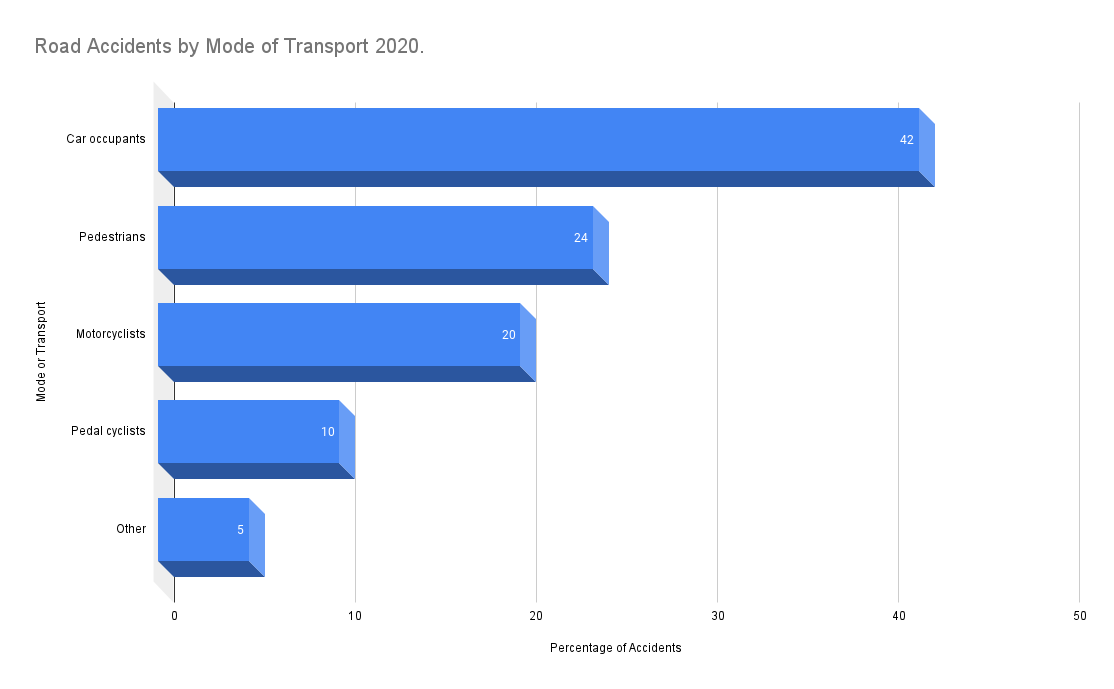
Steps You Could Take To Make A Car Accident At Work Claim
What happens when I have an accident at work? When making a personal injury case for a car accident at work claim, you will need to gather as much supporting evidence to back up your case. We have covered some of the things you can do below.
- Make sure to report the accident to your employer. Also, fill in the accident book if applicable.
- Seek professional medical attention, even for seemingly trivial injuries.
- Get the contact details of any witnesses.
- Gather information about the drivers and vehicles involved.
- Take photographs of the cause of the accident. You could also try to secure any CCTV footage available.
Who Is Liable?
If you intend to make a car accident at work claim, you need to show who was liable for the accident. A personal injury claim will not be possible if you cannot do this. In the following subsections, we look at who might be liable in what scenario.
When Employees Could Be Liable
If you caused the hazard that resulted in an accident, you may be liable yourself. In exactly the same way as you would in any road traffic accident. Regardless of the fact that you were driving for work. Speak to a personal injury lawyer to find out if you might be liable.
When Employers Could Be Liable
If your employer has provided you with an unsafe vehicle, they could be liable for an accident that this caused. You can speak to a personal injury solicitor for advice on how to prove a car accident was not your fault.
Other Parties Who Could Be Liable
It may be that your accident was caused because of the negligence of another road user or poor road conditions. In these instances, the claim would be made against either the other road user or the local council or highway agency.

Calculate Damages For A Work Vehicle Accident
When a personal injury claim is successful, the claimant can be awarded up to two types of damages. General damages will look to compensate for the pain and suffering the injuries have caused the claimant.
If the claimant qualifies for general damages, they could also ask to be compensated for special damages. These are financial losses or expenses, such as impacted income, caused by the personal injury.
Compensation Guidelines
We made this table based on the Judicial College Guidelines used by solicitors when calculating general damages. The JCG is useful for this task because the text suggests compensation brackets for various types of injuries.
| Health Problem | Severity | Compensation | More Info |
|---|---|---|---|
| Multiple severe injuries + financial losses | Severe | Up to £500,000+ | Financial impact can encompass lost earnings, medical expenses, and care costs. |
| Back | Severe (i) | £111,150 to £196,450 | Serious injuries involving damage to the spinal cord and nerve roots. |
| Bowels | Total loss of function | Up to £183,190 | For example, loss of function of the bowel, and the need for a colostomy bag to be used. |
| Neck | Severe (i) | In the region of £181,020 | Incomplete paraplegia or despite wearing a collar 24 hours a day no movement. |
| Eye | Loss of 1 eye | £66,920 to £80,210 | Compensation will consider mental health impact, age, and cosmetic effects. |
| Ankle | Severe | £38,210 to £61,090 | When a prolonged period of treatment is required and/or where pins and plates are inserted and there is a significant residual disability. |
| Jaw fracture | Very serious | £37,210 to £55,570 | For example, multiple fractures that require very long treatment and could have permanent effects. |
| Facial disfigurement | Significant facial scarring | £11,120 to £36,720 | Where applied cosmetic surgery has reduced most of the scarring. |
| Chest | Relatively simple injury | £15,370 to £21,920 | For example, a single puncture, which will have no long term consequences. |
| Foot | Modest | Up to £16,770 | Undisplaced metatarsal fractures, sprains and ligament injuries will be considered in this bracket. |
Chat With Us Today
How to Start A No Win No Fee Car Accident At Work Claim
Why not opt for a No Win No Fee solicitor to process your claim? Under a No Win No Fee agreement, you don’t pay your lawyer any fees until the claim is won. If you have more questions about a car accident at work claim, contact our team using the information below.
- Phone us on 0161 509 2856
- Contact us online
- Use the live chat feature to talk to an expert advisor in real time.
Employee And Vehicle Accident Claim Resources
Below, you can find links to lots more guides on accidents at work:
- Building and construction site accident claims
- What are the most common accidents at work?
- Can you sue your employer if you get hurt on the job?
Page by CR
Published by AL.
