 Skip to content


Last Updated On 23rd March 2026. If you’ve suffered a lift injury at your workplace, you may be wondering, ‘Can I claim for a lift accident at work?’ Fortunately, our team can help to assess your eligibility to start a lift accident at work claim. In all, you will need to demonstrate that you suffered injuries due to your employer’s failure to ensure your safety in a lift. Commonly, lift accidents can result from maintenance neglect, causing employees to get caught in doors, become stuck in lifts or fall into shafts. As such, lift accident injuries can encompass many physical and psychological forms, including PTSD, ankle fractures and serious crush injuries from closing doors. Due to this, lift accident compensation will be calculated uniquely; pay-outs could range from a few thousand pounds for minor cuts, to over £500,000 for serious crush injuries, amputations and severe financial losses.
At Advice, our advisors are available 24 hours, 7 days a week to answer your questions about stuck in lift at work claims. Through the free services that we offer, you could enjoy a free initial consultation to assess the strengths and weaknesses of your claim. Following this, you could be put through with one of our experienced accident at work solicitors to start your compensation claim. Under their services, you could enjoy help with evidence-gathering and negotiations on your behalf on a No Win No Fee basis.
To learn if you could claim for a lift accident at work, please contact the Advice team:
- Call us on 0161 509 2856
- Contact us by completing our online claim form
- Use our free live chat feature
Chat With Us Today
Browse Our Guide Sections
- Can I Claim For A Lift Accident At Work?
- How Could A Lift Injury At Work Occur?
- How Much Compensation Can I Get For Lift Accidents At Work?
- The Process For Claiming After A Workplace Lift Accident
- Why Make A Workplace Lift Accident Claim With Our Expert Solicitors?
- Claim For A Lift Accident At Work On A No Win No Fee Basis
- More Resources About Claiming For A Work Injury In A Lift
Can I Claim For A Lift Accident At Work?
While you are at work and performing your work duties, your employer owes you a duty of care. This is set out under the Health and Safety at Work etc. Act 1974 and states that employers must take any and all reasonably practicable steps to help prevent or minimise the risk of their employees becoming injured. This could include:
- Performing regular risk assessments.
- Maintaining any workplace equipment or machinery.
- Providing all employees with sufficient training on how to perform their working duties, such as manual handling training.
Additionally, the Lift Regulations 2016 establishes the comprehensive safety standards for elevators, lifts and related equipment. It was designed to protect the well-being of those who use or come into contact with lifts, as well as to safeguard property and the environment from potential hazards associated with lift operations.
If you have been injured in a work lift, you may be wondering, ‘Can I claim for a lift accident at work?’. To have a valid personal injury claim, the following criteria will need to be met:
- You were owed a duty of care at the date and time of the accident.
- This duty of care was breached.
- This breach caused you to suffer physical or psychological injuries.
However, it should be noted that your employer may not be responsible for the lifts within your building. This duty may be placed on the lift manufacturer or building owner. In these cases, you may need to make your claim against a different body.
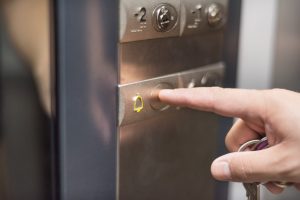
How Could A Lift Injury At Work Occur?
There are various ways that a lift accident could occur. Some examples could include:
- You could suffer an ankle injury when tripping due to the lift not aligning with the floor properly.
- Due to not being regularly maintained, the lift could malfunction and break down, causing you to become stuck inside it. This could then cause you to suffer from post-traumatic stress disorder (PTSD) or anxiety.
- The lift door malfunctions and closes too soon, causing you to suffer a hand injury and crushed fingers.
- The lift could suddenly drop, and this could cause you to suffer multiple injuries, such as a head injury and a leg injury.
These are only a few examples of potential accidents. If your accident is not listed here and you are wondering, ‘Can I claim for a lift accident at work?’, you can contact our advisors. They can assess the eligibility of your case and answer any additional questions you may have regarding the lift injury claims process.

How Much Compensation Can I Get For Lift Accidents At Work?
A successful personal injury claim for a lift or escalator accident could result in you receiving up to two heads of loss as part of your compensation settlement.
The first head of loss is called general damages, and it is awarded in all successful personal injury claims. It provides you with compensation for the physical and psychological injury you have endured, including the pain and suffering it has caused you.
Those valuing this head of your claim can refer to any medical evidence that has been submitted as well as the Judicial College Guidelines (JCG). Within this document is a range of different injuries alongside compensation guidelines. We have included some of these compensation guidelines within the table below, aside from the first entry.
However, please note that how much compensation you may receive will depend on the specific factors of your case. Therefore, you should only refer to this table as a guide.
Compensation Guidelines
| Type of Injury | How Severe? | Notes | Award Bracket Guidelines |
|---|---|---|---|
| Multiple Severe Injuries and Special Damages | Severe | Here the person will have suffered several severe injuries and the amount includes associated medical costs, loss of earnings and care provision. | Up to £200,000+ |
| Psychological Harm | (a) Severe | Here, the injured person will suffer marked problems coping with daily life and the prognosis will be extremely poor. | £66,920 to £141,240 |
| Hand | (c) Total or Effective Loss of One Hand | Cases where a hand suffered serious crush injuries and needed surgical amputation to all fingers and most of the palm. | £117,360 to £133,810 |
| Hand | (f) Severe Fracture to Fingers | Cases that might lead to partial amputation and leave deformity, impaired grip and lowered mechanical function. | Up to £44,840 |
| Post-Traumatic Stress Disorder (PTS) | (a) Severe | Permanent issues with stop the person from being able to function as they did before the trauma occurred. | £73,050 to £122,850 |
| Head | (d) Less Severe | A good recovery will have been made, but there may still be some persisting issues relating to memory and concertration. | £18,700 to £52,550 |
| Bladder | Almost complete recovery | Despite an almost complete recovery taking place, the person will still suffer with long-term interference with natural function. | £28,570 to £38,210 |
| Ankle | (c) Moderate | Fractures and ligament tears that create difficulty walking on ground that is uneven, navigating stairs or standing and walking for long periods. Risk of osteoarthritis increased. | £16,770 to £32,450 |
| Foot | (f) Moderate | Cases of metatarsal fractures that are displaced and cause a continuation of symptoms and a permanent deformity. | £16,770 to £30,500 |
Special Damages In Lift Accident Claims
The second head of loss you may receive as part of your compensation is called special damages. The financial harm your injury has caused you to experience is compensated under this head of loss.
To be able to claim for these losses as part of your lift accident claim, you will need to present evidence of them. This could include, but is not limited to:
- Payslips that show a loss of earnings due to you needing to take time off work to recover from your injuries.
- Invoices for any care costs if you required at-home care.
- Receipts for any prescription fees.
- Train or bus tickets to essential appointments, such as medical appointments.
To discuss your potential compensation claim, you can contact a member of our advisory team. They could also provide you with a free valuation for your case.
Chat With Us Today
The Process For Claiming After A Workplace Lift Accident
If you’ve been injured in a lift and believe that your employer may be responsible, there are several practical steps that you could take to strengthen your legal position. As such, please see the below actions that you could follow after a lift accident at work:
-
- Get Medical Help. After a lift accident, your first priority should be seeking treatment for any physical and mental injuries. Whether you visit your GP, an urgent care clinic or A&E, seeking treatment can aid your recovery and create official medical records of your lift accident at work.
- Secure Evidence About The Incident. When safe and appropriate to do so, you should gather evidence close to the time of the accident. In doing this, you should take photographs of the hazard involved, gather lift maintenance logs, obtain CCTV footage and contact details of potential witnesses.
- Create An Official Record Of The Lift Accident. You should ensure that the incident is entered into your workplace’s accident log book to create an official record.
- Keep Track Of Your Injuries. You should keep a symptoms diary to record your day-to-day pain levels, mobility issues and psychological effects. You should also detail any treatments you receive and your financial losses, including lost income and medical expenses.
- Obtain Advice From A Specialist Solicitor. You should seek advice from a personal injury specialist; through their services, you could enjoy an eligibility assessment and receive a compensation estimate.
- Ensure You’re Within The Legal Limit. In most personal injury cases, claims must be started within 3 years of the accident date. However, there are certain exceptions to this time limit.
To discuss exceptions to the personal injury time limit, please feel free to get in touch today.

Why Make A Workplace Lift Accident Claim With Our Expert Solicitors?
You should make a workplace lift accident claim with our expert solicitors due to their dedication to achieving the compensation that you deserve. Through their bespoke and high-quality services, you could enjoy the following benefits:
- Knowledgeable assistance with lift accident claims, ensuring that details such as a lack of maintenance or a failure to perform repairs are not overlooked.
- Putting your health and recovery first by connecting you with physiotherapists and counsellors.
- Regular case updates so you’re never left wondering where your lift accident claim stands.
- Helping you to answer questions such as, ‘Can I claim for a lift accident at work?’
- Assistance with gathering evidence, including CCTV footage and workplace accident logs.
- Helping you to apply for interim payments for any emergency costs.
To learn if you could be connected with one of our specialist solicitors, please don’t hesitate to contact our advisory team.
Claim For A Lift Accident At Work On A No Win No Fee Basis
You may also be wondering, ‘Can I claim for a lift accident at work on a No Win No Fee basis?’. Provided that you have a valid case, one of our No Win No Fee solicitors could help you through the claiming process.
By offering to represent you under a specific form of No Win No Fee agreement known as a Conditional Fee Agreement (CFA), you will not be required to pay them anything upfront for them to begin working on your case. You also will not need to pay them for their services while the claim is underway or if it ends unsuccessfully.
However, you will be required to pay them a success fee if you are successfully awarded compensation. This fee will be taken directly from your compensation as a small percentage. There is a legal limit that caps the maximum percentage that this success fee can be.

Contact Our Team Today
If you have suffered a psychological or physical injury and are wondering, ‘Can I claim for a lift accident at work?’, you can contact one of our advisors. They can assess the eligibility of your case, offer you free advice and answer any questions you may have about the claiming process. Additionally, they could also put you in contact with one of our No Win No Fee solicitors if it seems like you have a strong case.
To connect with our team today, you can:
- Call 0161 509 2856
- Contact us online to receive a callback.
- Ask a question using the live chat pop-up.
More Resources About Claiming For A Work Injury In A Lift
- A guide about Post-Traumatic Stress Disorder (PTSD) from the NHS.
- Some information about passenger lifts and escalators from the Health and Safety Executive (HSE).
- Lastly, help from the charity Anxiety UK about support options for sufferers of anxiety.
Thank you for reading this guide. If you are still wondering, Can I claim for a lift accident at work?’, you can contact one of our advisors.
